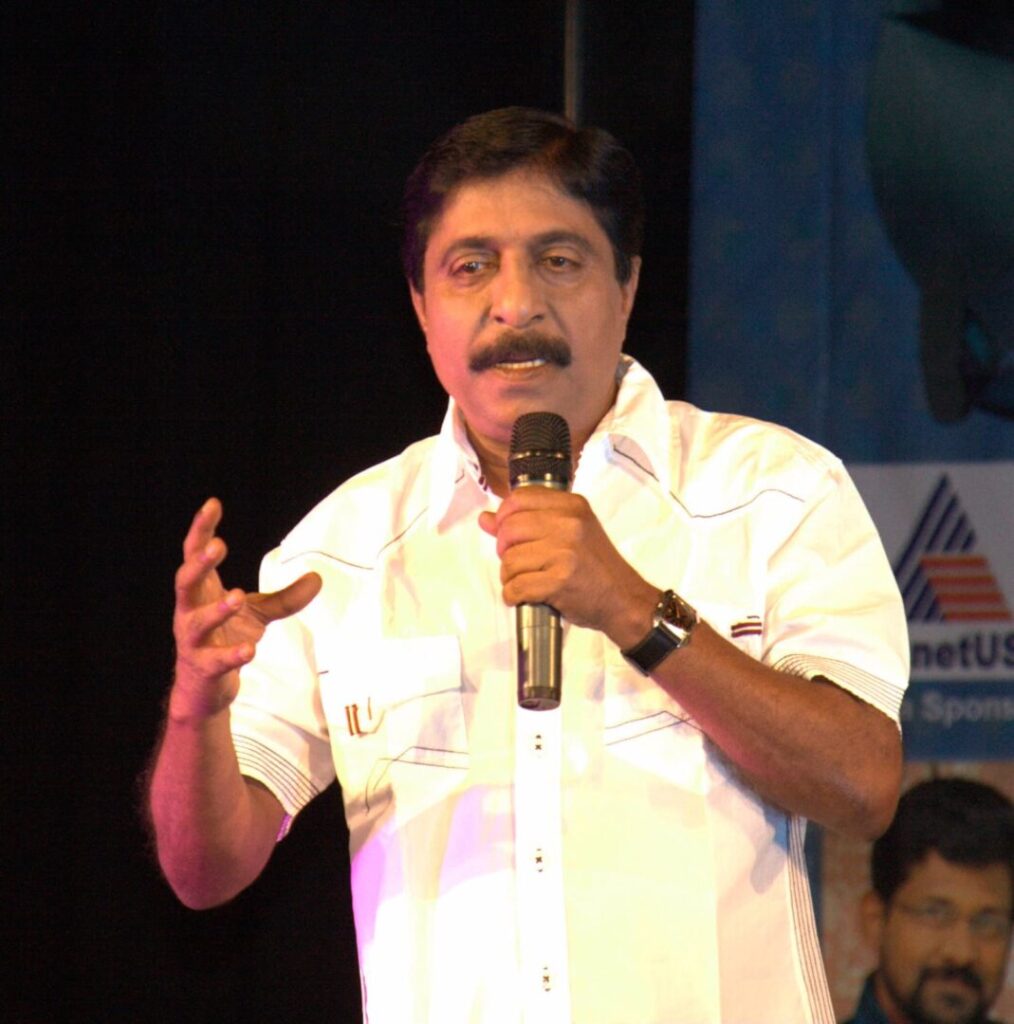
Veteran Malayalam actor, director, and screenwriter Srinivasan died recently at 69. He had been unwell for several years, with rumors of his death even spreading last year after an emergency hospital visit. His prolonged illness left him extremely frail. He needed help to walk, his speech was hard to understand, and his once-sharp voice had diminished to a squeak. Yet he appeared on many TV shows as a guest, likely helped by the fact that both his sons are now well-established in Malayalam cinema. But for fans like me, who cherished Srinivasan at his creative peak, watching this steady physical and mental decline was painful. Because of that, I had stopped watching any of his recent TV and film appearances. So, I won’t miss him now that he is gone.
But he will never be forgotten. As an aspiring comic, I often build castles in the air, dreaming of spectacular success, followed by acceptance speeches and interviews. One vivid dream is being interviewed by The New Yorker’s David Remnick at a standing-room-only event. Remnick begins by asking about my comedic influences, and I answer that it all began with Srinivasan. I have been walking around with that Srinivasan acknowledgement speech in mind for a long time.
In the early nineties, I used to live with my younger aunt, Lakshmi, and we would watch the weekend Malayalam movie on TV together. In those days, all I knew about a film was the names of its leading stars, and in some rare cases, its director. In many of these movies, a dark-skinned, “unattractive” (by Malayalam standards) buffoon of a character would appear briefly. He would deliver razor-sharp, self-deprecating lines, mostly about his looks or intellect, and become the butt of everyone’s jokes. Yet he was unforgettable for his comedic timing and biting humor. I couldn’t stop talking about him to my aunt, and she would sometimes say, exasperated, how strange it was that I was blown away by this sidekick instead of talking about the hero who carried the film.
Many years later, as I became better educated about Malayalam cinema, I realized, with surprise and secret pride, that this clownish sidekick was none other than Srinivasan himself, the scriptwriter of those very films. In fact, many of the movies I watched then are now considered classics of social and political satire. Their one-liners have become part of the Malayali lexicon. Lines like “everything has its time, Daasa,” or “the beautiful impossible dream that never came true” lose some magic in translation. But a Malayali instinctively says “touché” when hearing them, because they capture Kerala’s essence so accurately.
Without realizing it at the time, growing up on Srinivasan’s political and social satire prepared me to appreciate similar cinema in the West when I moved to the US. I hadn’t watched many English movies in India, and my only exposure to English comedy was Laurel and Hardy. Yet I took to Woody Allen’s films like a fish to water. Humor, I learned, is universal when it’s rooted in insight.
Srinivasan’s comedy was intelligent, rooted in a well-read, observant mind. Who else could weave a line about Polish politics into a film and make it eternally quotable? The line managed to discuss foreign politics while also poking fun at the Malayali who is politically hyper-aware yet too lazy to work. It is said that Oscar Wilde could effortlessly raise the intellectual level of others around him with his wit without sounding preachy. That was Srinivasan, too. Perhaps it came from his belief that cinema’s primary purpose is to entertain. Only he could make a blockbuster that mocked the film industry’s obsession with stars, while the real star is always the film’s script.
He directed only two films, both superhits and now classics. Both were unapologetically feminist, with him gladly playing the butt of male insecurity. One explored an ordinary-looking husband’s jealousy about his beautiful wife. The second dealt with spirituality, showing a husband who uses his “spiritual quest” to dump the responsibility of running the house on his wife. The diminutive wife eventually finds her voice, and the film argues that true spirituality lies not in escaping responsibility but embracing it. At their core, his films captured the Malayali male’s tendency to hide laziness behind politics, philosophy, and pride. It’s a running joke that y Malayalis work hard only after leaving Kerala.
As Srinivasan’s stature grew, he began speaking at public forums, and I often watched his YouTube videos. He was an excellent orator, with the same wit and punch as in his films. In one speech skewering the increasing communal divisions in Kerala, he recalled getting married during his struggling days, and how loans from a Christian and a Muslim friend funded his Hindu wedding. Another memory that stays with me is of him laughing proudly at his younger son’s wedding when his elder son, a filmmaker and singer, said there was no better way to honor the Hindu groom and Christian bride than with a Muslim song, and then sang one.
As an ardent fan, I was glad Srinivasan lived to see his sons succeed, even as his health failed. Early interviews with his family are pretty popular, especially because of his younger son’s outrageous candor. Srnivasan is often the butt of jokes in these interviews. Still, when the interviewer (stupidly) asks the younger son whether he regrets not being the son of a superstar actor, he replies firmly, “My dad is a superstar.” I realized the depth of my own love for him when I bought a DVD of Srinivasan’s funniest clips for someone I loved, and then couldn’t bring myself to part with it.
Srinivasan was unapologetically himself. He often said his only mantra was never to pretend to be someone else, and to be aware that he knew nothing. His intellect was not a badge of superiority but a form of self-sufficiency. His was a life richly lived, and he gave Malayalis, often egotistic and negative, the freedom to laugh at themselves.
Adieu for now, Srinivasan, until the David Remnick interview.