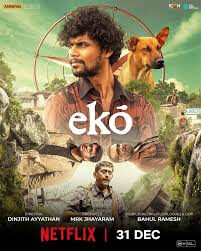
Man’s best friend protects like no other.
This blockbuster is the third in a trilogy of animal-centric thrillers by writer and cinematographer Bahul Ramesh, who reunites with director Dinjith Ayyathan after their first acclaimed outing, Kishkindha Kandam (in which monkeys played a key role). Dogs take center stage in Eko.
Eko, despite being a thriller with violence and gore, flows like a lyrical poem because of its barebones but razor-sharp script and breathtaking locales. This could be why Ramesh is getting more attention than Ayyathan: usually, the director is the toast of the town after a hit. It also shows the audience’s evolution in recognizing the scriptwriter and cinematographer of good films. Eko also trusts the audience’s intelligence to figure out its plot and explosive climax. I had to watch the film a couple of times to grasp the chronology of events (Ramesh was inspired by Nolan’s non-linear scripts). But Eko’s beauty is that it holds up to multiple viewings, despite being a mystery-thriller. As a friend said, “Eko was lovely, but I didn’t understand the ending.” I had to explain it to her, but Eko is a winner either way. This could be why, in one of his interviews, Ramesh says the team is overwhelmed by the audience response; they were just hoping their efforts to make a special film would be noticed.
The film is about a notorious businessman and famed dog trainer, Kuriachan, who has been missing for more than five years after a crime. The cops and even some of his enemies are looking for him, but he has vanished without a trace. Some suspect he is hiding in a cave in the hills around his home, aided by his trained Malay pure-bred dogs. They snarl and are ready to attack once you are on his vast property and are also trained to fetch food from the forest. His wife, the elderly Mlaathy (a Malayan), lives alone in their house atop the hills and refuses to go elsewhere. Her sons have recently arranged for a young boy, Peeyoos (Sandip Pradeep), to take care of her after a bout of illness. They want her to move to the town so that they can sell their estate before Kuriachan’s other illegitimate kids stake any claims. But Mlaathi will not budge.
A new investigator, a naval officer, appears on the scene and convinces Peeyoos to report any discovery of Kuriachan to him first by offering a higher reward than the police. We see Peeyoos sensing dread in the air; he is often followed when walking home through the woods. The last man to actively appear on the scene a few years back was Kuriachan’s once close friend Mohan, but he mysteriously dies falling off a cliff. The new investigators question Mlaathi, but as she points out, the cops have already questioned her about everything. Mlaathi is a mysterious character (rumored to practice black magic) and lets the dogs breed. But she does not feed them because that creates dependence, and she wants them to roam free (a clever tip of the hat to the film’s theme).
Through a series of flashbacks, we learn the backstory of how a young Mlaathi, who used to live with her dog-breeder husband in Malaysia during the Vietnam War, came to this lonely part of Kerala. Kuriachan and Mohan, dog breeders from Kerala, are looking for purebred dogs and end up as their guests. During a trip with the two men, her husband is arrested, and it becomes unsafe for Mlaathi to live alone. Kuriachan then offers to marry her and brings her to his home in Kerala. Kuriachan is not the faithful kind, although there are no obvious signs of disrespect. When Mohan comes looking for Kuriachan, Mlaathi learns the truth about her husband. We also learn about Peeyoos’s identity through a couple of men who follow him.
The film’s climax is explosive and satisfying as clues about Kuriachan’s whereabouts are revealed. The climax is a culmination of the film’s theme that “sometimes protection and restriction look the same.” It is a master class in writing because many writing teachers emphasize that a good story has a single, clear premise.
Eko is sparse: very few characters appear in the film, yet, like the mountains where the story unfolds, it feels more solitary than lonely. I wish I could have seen it on the big screen to take in the views. Even the superbly choreographed fight scenes have earthiness and languor. Mujeeb Majid’s score is an integral part of the film, adding to its foreboding mood while remaining grounded, like nature. Although in Indian cinema, film music is mostly associated with film songs, many of Eko’s background score pieces have become popular.
Since the film has only a handful of actors, they must deliver. Young Sandeep Pradeep does not hit one false note. I watched the ending scene so many times to see his face go through the full gamut of emotions, from feigned innocence to anger. He is perfectly cast and carries the film confidently. Meghalayan actress Bianna Momin, in her debut as Mlaathi, is another casting coup and a perfect counterpoint to Sandeep’s youthful exuberance. She is as stoic as the mountains around her, says little, but her stillness speaks volumes. A big reason her performance pops is the superb dubbing by theater veteran KPAC Leela; the voice is fresh and does justice to the film’s sparse dialogue. Mlaathi’s voice was so impactful that the first thing I did after watching the film was to look up who spoke the Mlaathi lines. But the filmmakers, attuned to their audience, were a step ahead and already had an Instagram post honoring Leela for her commendable work.
The other actors are also remarkable, especially Narain as the naval officer who arrives to nab Kuriachan, Binu Pappu as a decoy cop, veteran actor Asokan as Kuriachan’s trusted aide Appootty, and Saheer Mohammad as the ex-cop Papachan. Even the two Malay actors Sim Zhi Fei and Ng Hung Shen are surprisingly good as the young Mlaathi and her husband, especially the latter. The dogs that are the film’s spine shine (they had to train forty dogs for all the scenes). CGI was used only to erase their trainer from the scenes. What was most gratifying was that the dogs looked like the local dogs of Kerala, who, because of their plain looks, are rarely kept as pets and often end up as strays because people prefer the more exotic breeds.
Well, even Eko’s filmmakers are human and make missteps. Saurabh Sachdeva, a solid Bollywood actor, is woefully miscast as the missing Kuriachan. He plays the arrogant and cruel Kuriachan with over-the-top theatrics, the kind expected in Bollywood, but it sticks out like a sore thumb in the understated Eko. The filmmakers say they were looking for a fresh face (and I suspect pan-Indian appeal), but the Malayalam industry is teeming with top-notch character actors who could have done justice to the role. Thankfully, his screen time is minimal, and as someone commented, they could have kept him off-screen like the shark in Jaws. Mohan, Kuriachan’s friend-turned-foe, is another meaty role. Veteran Malayalam actor Vineeth is adequate and by no means messes up (some scenes are tricky), but he does not elevate his character either because it could have become an iconic role.
But these minor hiccups soon go away, and you can relish the gourmet meal called Eko.