Who is a real father?
Although I enjoyed OBAA when I first saw it, I didn’t think it held up to a rewatch. But I still went back to see its nuances (I have seen it three times on IMAX now) and was surprised that the film moves faster each time. Which is why I think the film’s unsung hero is its editor Andy Jungerson. From the second watch on, I also marveled at how much Jonny Greenwood’s spectacular score helps the film maintain its tempo and epic quality. It takes a village to make a film, and PTA’s A team is on steroids on this one.
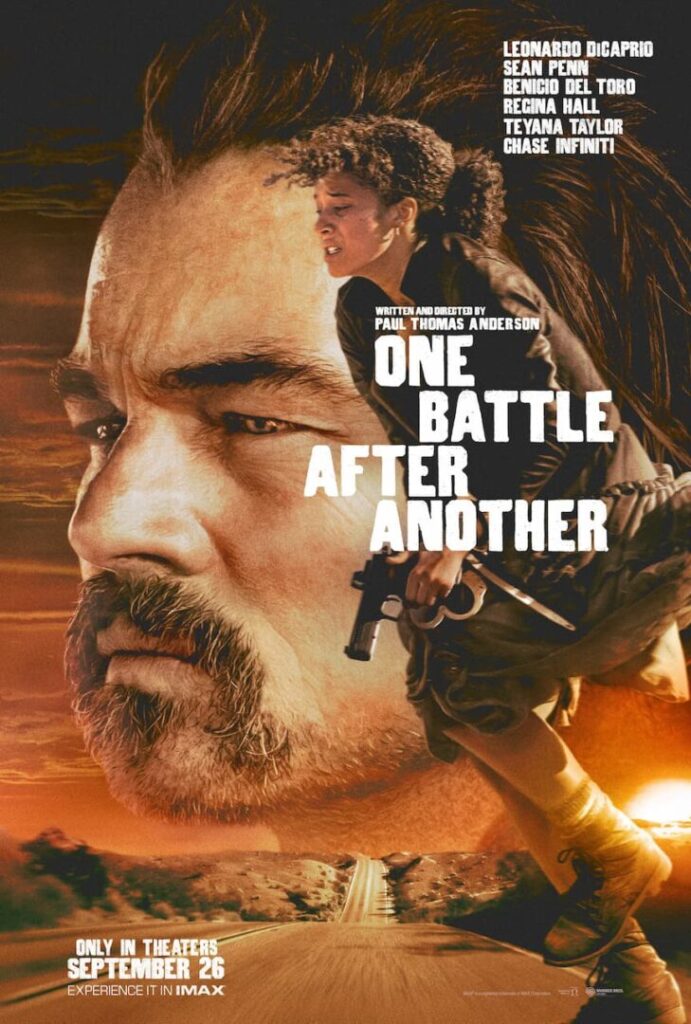
The film is PTA’s longstanding pet project, loosely based on Thomas Pynchon’s Vineland. At its core, the film is about a father’s love for his daughter and how he risks it all to protect her. Bob Ferguson (Leonardo DiCaprio), a former bombmaker for the now-defunct revolutionary group the French 75, is raising his feisty daughter, Willa (Chase Infiniti), alone. Her mother and his lover, Perfidia (a perfectly cast Teyana Taylor), the former head of the movement, has disappeared after escaping from her witness protection program with Captain Lockjaw (Sean Penn). Lockjaw, Perfidia’s brief lover and protector, has been hunting her and her family since her escape. More than fifteen years later, Lockjaw receives reliable information about Perfidia’s daughter and Bob, and the chase is on.
The French 75, although inactive, still exists and uses its networks to warn Bob. Willa, who is at a party, is rescued by Deandra (Regina Hall). Bob manages to escape before Lockjaw lands at his home and approaches Willa’s Karate-do teacher, Segio (Benicio del Toro), to help
him get to his daughter. Sergio, who also runs an underground operation that houses immigrants, is an admirer of the French 75 and therefore helps Ben. Lockjaw meanwhile traces down Willa, and his suspicion that she might be his daughter is confirmed. But he is trying to be part of a white supremacist organization and cannot afford to have a mixed-race daughter, and decides to dispose of her (he has a higher calling, he says). Ben overcomes many mishaps and finally finds his daughter, and Lockjaw is disposed of in the most hilarious yet befitting way. Willa, despite knowing about her biological father and getting her mom’s letter from hiding, realizes that Ben is her “real” father. We see her following her mother’s footsteps as a revolutionary, but under her father’s resigned yet watchful eye.
PTA throws everything into this already complicated plot, including a vertigo-inducing car chase, immigration raids, hotheaded but directionless revolutionaries, you name it. But as PTA says, people don’t care about car chases; they care about the people in the cars, and that’s where his writing steps in. We care even about the most minor characters, be it the revolutionary blindfolded by the police, the young boy who comes to pick up Ella and becomes the object of her dad’s wrath, the nun who runs the establishment, or the nurse trying to save Bob.
Most of the roles, given the film’s manic energy, could become cartoonish. At the top of the list is the ludicrous white supremacist club calling itself the Christmas Adventurers Club. The actors (top-notch casting here), Kevin Tighe, D. W Moffet, Tony Goldwyn, and their hitman, Tim, played by John Hoogenakker, play their roles so seriously, you laugh at their ridiculousness but also fear them. I felt sad when hitman Tim died unnecessarily; he was a great assassin who did his job perfectly as required.
That’s the beauty of PTA’s writing; every character is sincere about what they are doing – the audience judges whether they are good or bad. For instance, take the supervillain Lockjaw, played by Sean Penn in a spectacular performance, with a distinctive mean yet vulnerable walk (my neighbor chuckled in amazement each time he appeared on screen). He is a brute in his immigration crackdown, but cannot help loving the black Perfidia; he even takes her flowers (a small but poignant image). He regrets not being able to bond with his daughter, but the devil’s pull is beyond his control, and we can sense his agony. His tough veneer cracks before the members of the Christmas Adventurers Club. He is a bumbling kid wanting to please them and be accepted. I wondered if poor Lockjaw’s parents loved him as a child?
Leonardo DiCaprio carries the film’s tempo, dishevelled and high, his fleeing skills rusty, but back when his daughter is in danger. Bob’s character’s only heroism is his intense love for his family, and he’s aided by lucky breaks rather than skill. One of the most beautiful scenes I have seen in films is of the three young skateboarders running and leaping like gazelles in the sunset, guiding a plodding older Bob to safety. Only PTA could think of a scene like that, and the background score makes it magical. A lesser actor could have made the role caricaturish, but Leonardo soars (his relief and joy when he finally finds Willa is a master class in acting). The guy even manages to look physically boyish at the beginning of the film before easing into his dad bod for the rest of the film.
DiCaprio’s counterpoint is the Zen-like Sergio, played by the sublime Benicio Del Toro, a large teddy bear but totally in control of his domain. You can see why he commands complete loyalty from everyone around him. PTA says the challenge was to make sure that Del Toro did not absorb any of DiCaprio’s manic energy. Again, Sergio’s role could have also become caricaturish, but Del Toro’s charm is so large and infectious that I was outright annoyed when he exited the film. Much is made of the film’s discovery, Chase Infiniti, but I thought she was the weakest link, especially on repeat viewings. Still, with her breathtaking and unique looks and abundant spunk, she plods on gamely with the experienced cast. I wish there were more scenes between her and Leo; their father-daughter chemistry is undeniable and moving. Regina Hall seems wasted with her one-tone performance, although I suspect much has been lost on the editing floor. Another character who stood out was the actor Eric Schweig, a bounty hunter with values (no kids); you can sense the integrity and menace in his still physical performance.
It takes a lot of effort to make something look simple, and I can only imagine the work that went into the film. This is PTA’s first epic-style film, and it is shot in Vista Vision (another first). Producer Sara Murphy and DP Michael Bauman discuss the extensive two-year location scouting, the actors’ improvisations, and the bulkiness of the cameras. An actor I know echoed the same views. His source, Jonathan Demme’s son, Brooklyn (who briefly appears in the film as one of the revolutionaries), told him the mood on the set was dead serious, with everyone focused on getting the work done.
Watching the film convinced me that actors earn their paychecks, unlike Wall Street brokers who play with others’ hard-earned money. The blood and sweat are visible on screen, not to mention that of the behind-the-scenes crew. Watching One Battle after another in a packed IMAX theater with the audience hooting and hollering in appreciation with every twist and turn in the movie and wildly applauding at the end, made me realize how few of these positive communal experiences we still have. Thank you, PTA and crew; let’s keep the battle to keep cinemas alive.